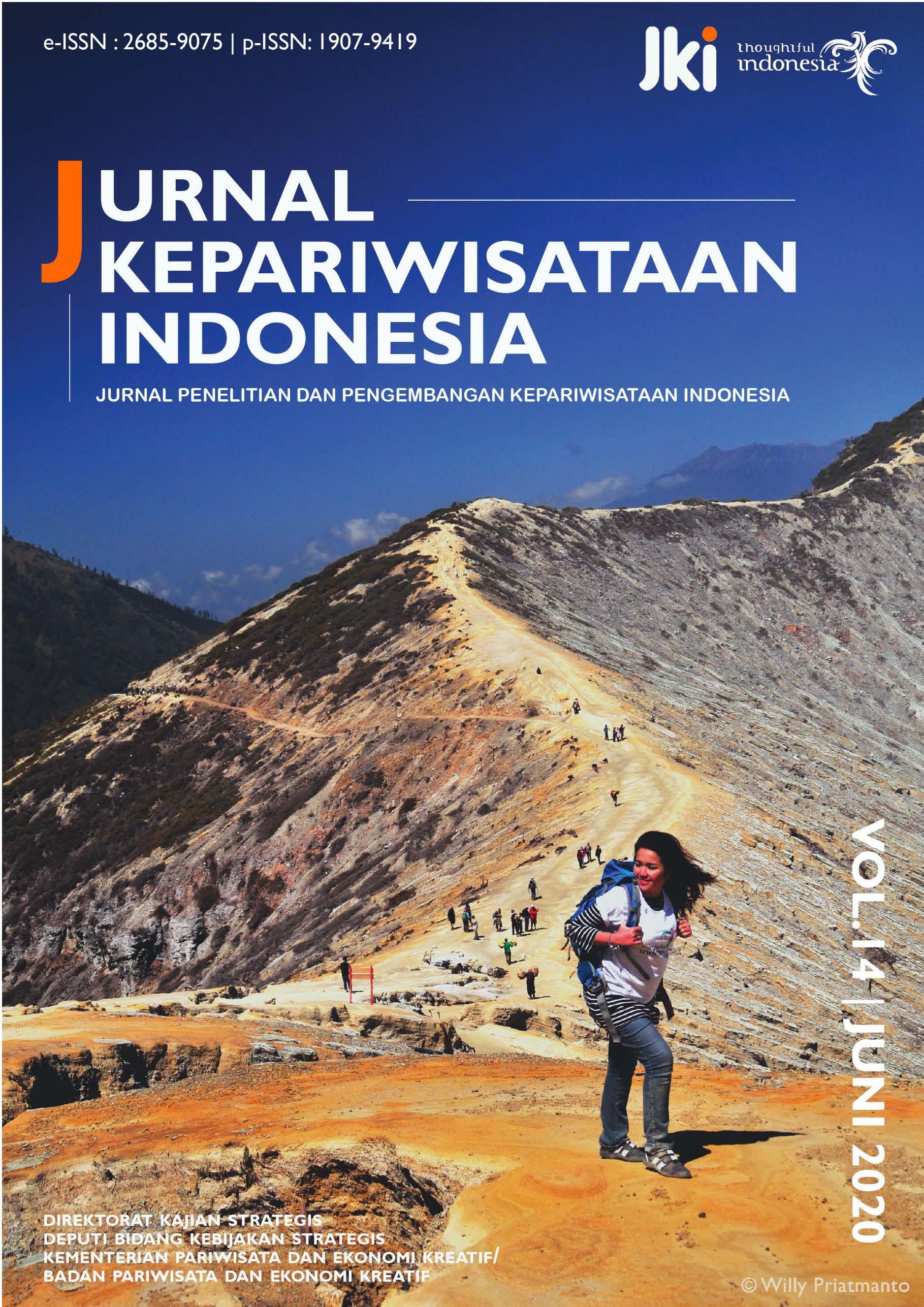
Pariwisata Berbasis Alam: Memahami Perilaku Wisatawan
DOI:
https://doi.org/10.47608/jki.v14i12020.46-52Keywords:
Nature-Based Tourism; Perilaku wisatawan; Teori Interaksional; InterpretasiAbstract
Tujuan dari penelitian ini adalah memahami perilaku wisatawan dalam fungsi interaksi di suatu destinasi pariwisata khususnya kepariwisataan di Indonesia dengan menggunakan metode bibliometric study atau dengan metode penelitian dari data sekunder. Hasil dari penelitian ini menunjukkan bahwa interpretasi yang baik akan sangat mempengaruhi suatu destinasi dan calon wisatawan yang akan mengunjunginya. Semakin tinggi nilai tambah suatu destinasi yang ditawarkan kemudian ditambah interpretasi yang baik maka semakin menarik calon wisatawan untuk melakukan perjalanan, khususnya Nature-Based Tourismyang sejatinya memiliki banyak hal untuk dipelajari oleh wisatawan.
Downloads
References
Altman, I., & Rogoff, B. (1987). World views in psychology: Trait, organismic and transactional approaches. In The handbook of environmental psychology (Vol. 1).
Archer, D., & Wearing, S. (2003). Self, space, and interpretive experience: The interactionism of environmental interpretation. Journal of Interpretation Research, 8(1), 7–23.
Ardoin, N. M., Wheaton, M., Bowers, A. W., Hunt, C. A., & Durham, W. H. (2015). Nature-based tourism’s impact on environmental knowledge, attitudes, and behavior: A review and analysis of the literature and potential future research. Journal of Sustainable Tourism, 23(6), 838–858. https://doi.org/10.1080/09669582.2015.1024258
Ballantyne, R., Packer, J., & Falk, J. (2011). Visitors’ learning for environmental sustainability: Testing short- and long-term impacts of wildlife tourism experiences using structural equation modelling. Tourism Management, 32(6), 1243–1252. https://doi.org/10.1016/j.tourman.2010.11.003
Ballantyne, R., Packer, J., & Sutherland, L. A. (2011). Visitors’ memories of wildlife tourism: Implications for the design of powerful interpretive experiences. Tourism Management, 32(4), 770–779. https://doi.org/10.1016/j.tourman.2010.06.012
Cater, C., & Cater, E. (2007). Marine ecotourism: Between the devil and the deep blue sea (Vol. 6). Cabi.
Christie, M. F., & Mason, P. A. (2003). Transformative Tour Guiding: Training Tour Guides to be Critically Reflective Practitioners. Journal of Ecotourism, 2(1), 1–16. https://doi.org/10.1080/14724040308668130
Cousins, J. A. (2007). The role of UK-based conservation tourism operators. Tourism Management, 28(4), 1020–1030. https://doi.org/10.1016/j.tourman.2006.08.011
Dann, G. M. S. (1981). Tourist motivation an appraisal. Annals of Tourism Research, 8(2), 187–219. https://doi.org/10.1016/0160-7383(81)90082-7
Fridgen, J. D. (1984). Environmental psychology and tourism. Annals of Tourism Research, 11(1), 19–39. https://doi.org/10.1016/0160-7383(84)90094-X
Harrill, R., & Potts, T. D. (2002). Social Psychological Theories of Tourist Motivation: Exploration, Debate, and Transition. Tourism Analysis, 7(2), 105–114. https://doi.org/10.3727/108354202108749989
Hughes, K., Packer, J., & Ballantyne, R. (2011). Using postâ€visit action resources to support family conservation learning following a wildlife tourism experience. Environmental Education Research, 17(3), 307–328. https://doi.org/10.1080/13504622.2010.540644
Iso-Ahola, S. (1980). The social psychology of leisure and recreation. Dubuque, IOWA. W. C. Brown Company Publishers.
Junianti, R. A., Soekmadi, R., & Santoso, N. (2016). Perencanaan Program Interpretasi Lingkungan. Risalah Kebijakan Pertanian Dan Lingkungan, 3(2), 153–161.
Mannell, R. C., & Iso-Ahola, S. E. (1987). Psychological nature of leisure and tourism experience. Annals of Tourism Research, 14(3), 314–331. https://doi.org/10.1016/0160-7383(87)90105-8
Marion, J. L., & Reid, S. E. (2007). Minimising Visitor Impacts to Protected Areas: The Efficacy of Low Impact Education Programmes. Journal of Sustainable Tourism, 15(1), 5–27. https://doi.org/10.2167/jost593.0
Mason, P., & Christie, M. (2003). Tour Guides as Critically Reflective Practitioners: A Proposed Training Model. Tourism Recreation Research, 28(1), 23–33. https://doi.org/10.1080/02508281.2003.11081383
Patterson, T., Gulden, T., Cousins, K., & Kraev, E. (2004). Integrating environmental, social and economic systems: A dynamic model of tourism in Dominica. Ecological Modelling, 175(2), 121–136. https://doi.org/10.1016/j.ecolmodel.2003.09.033
Pearce, P. (2013). The social psychology of tourist behaviour: International series in experimental social psychology (Vol. 3). Elsevier.
Plog, S. (2004). Leisure travel: A marketing handbook (pp. 47-72). Upper Saddle River, NJ: Pearson Prentice Hall.
Plog, S. C. (1974). Why Destination Areas Rise and Fall in Popularity. Cornell Hotel and Restaurant Administration Quarterly, 14(4), 55–58. https://doi.org/10.1177/001088047401400409
Powell, R. (2005). Nature-based tourism within protected areas: Effects of participation on knowledge, attitudes, values, and behaviors and the factors that influence these outcomes. Yale University.
Powell, R. B., Green, T. F., Holladay, P. J., Krafte, K. E., Duda, M., Nguyen, M. T., Spencer, J. H., & Das, P. (2018). Examining Community Resilience to Assist in Sustainable Tourism Development Planning in Dong Van Karst Plateau Geopark, Vietnam. Tourism Planning & Development, 15(4), 436–457. https://doi.org/10.1080/21568316.2017.1338202
Powell, Robert B., Brownlee, M. T. J., Kellert, S. R., & Ham, S. H. (2012). From awe to satisfaction: Immediate affective responses to the Antarctic tourism experience. Polar Record, 48(2), 145–156. https://doi.org/10.1017/S0032247410000720
Powell, Robert B., Kellert, S. R., & Ham, S. H. (2009). Interactional Theory and the Sustainable Nature-Based Tourism Experience. Society & Natural Resources, 22(8), 761–776. https://doi.org/10.1080/08941920802017560
Rattan, J. K., Eagles, P. F. J., & Mair, H. L. (2012). Volunteer tourism: Its role in creating conservation awareness. Journal of Ecotourism, 11(1), 1–15. https://doi.org/10.1080/14724049.2011.604129
Republik Indonesia. (2011). Peraturan Pemerintah (PP) tentang Rencana Induk Pembangunan Kepariwisataan Nasional Tahun 2010 -2025. 3. https://peraturan.bpk.go.id/Home/Details/5183/pp-no-50-tahun-2011
Ritchie, B. W., Bentley, G., Koruth, T., & Wang, J. (2011). Proactive Crisis Planning: Lessons for the Accommodation Industry. Scandinavian Journal of Hospitality and Tourism, 11(3), 367–386. https://doi.org/10.1080/15022250.2011.600591
Sekretariat Konvensi Keanekaragaman Hayati. (2004). Sekretariat Konvensi Keanekaragaman Hayati.
Tang, L. (Rebecca). (2014). The application of social psychology theories and concepts in hospitality and tourism studies: A review and research agenda. International Journal of Hospitality Management, 36, 188–196. https://doi.org/10.1016/j.ijhm.2013.09.003
Wearing, S., & Archer, D. (2003). An’interpretation opportunity spectrum’: A new approach to the planning and provision of interpretation in protected areas. Riding the Wave of Tourism and Hospitality Research.
Werner, S., Buser, K., Kapp, A., & Werfel, T. (2002). The incidence of atopic dermatitis in school entrants is associated with individual life-style factors but not with local environmental factors in Hannover, Germany. British Journal of Dermatology, 147(1), 95–104. https://doi.org/10.1046/j.1365-2133.2002.04782.x
Wheaton, M., Ardoin, N. M., Hunt, C., Schuh, J. S., Kresse, M., Menke, C., & Durham, W. (2016). Using web and mobile technology to motivate pro-environmental action after a nature-based tourism experience. Journal of Sustainable Tourism, 24(4), 594–615. https://doi.org/10.1080/09669582.2015.1081600
Wight, P. (2001). Ecotourists: Not a homogenous market segment. In The encyclopedia of ecotourism (D. Weaver, pp. 37–62). CABI Publishing.