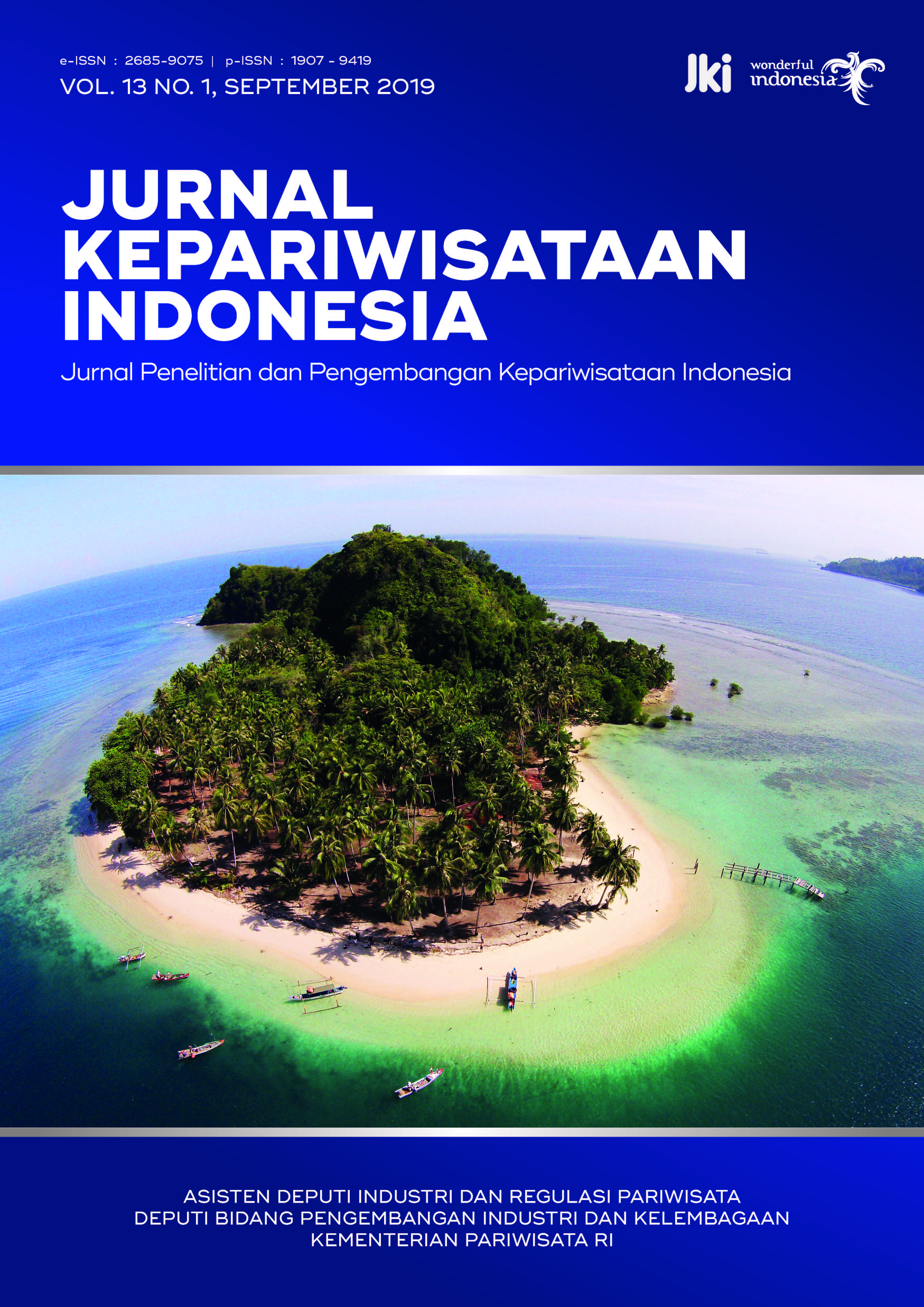
Produk Pariwisata Berbasis Ekologi di Ha Long Bay, Vietnam
DOI:
https://doi.org/10.47608/jki.v13i12019.31-42Keywords:
Ha Long Bay, destination management, world heritageAbstract
Ha Long Bay is one of eminent tourist destinations in Vietnam. This destination has been attaining international recognition for its landscape beauty and uniqueness, besides its geological values inside the region. There has been an increasing number on tourist arrivals since Ha Long Bay declared as UNESCO Heritage Sites in 1994. However, the increasing of tourist visitors teamed with some problematic issues related to environment and certain conflicts between tourism and protection to natural heritage. This paper discussed the issues and government efforts to manage Ha Long Bay tourist destination. Research Method used is qualitative and descriptive data analysis. Data sources derived from primary and secondary data. The result of the research shows that Vietnamese Government has issued Strategy on Vietnam’s Tourism Development until 2020, Vision to 2030 and Vietnam’s Sustainable Development Strategy for 2011-2020. Ha Long Bay Management Board becomes the leading sector in Ha Long Bay management, which has been doing partnership with international organizations, involving local government, private sectors and local communities. These become an important point for the implementation of Action Plan for Preservation of the Ha Long Bay Heritage, to achieve quality tourism and sustainability of Ha Long Bay environment.
Downloads
References
Clayfield, Matthew (2015). Tourism, coal shipping turning Vietnam's Ha Long Bay into an 'ecological disaster'. Freelance contributor in Vietnam. http://www.abc.net.au/news/2015-10-02/tourism-coal-shipping-vietnam-ha-long-bay-rubbish/6821568 diakses 7 September 2017
Creswell, J. W. (2009). Research Design: Qualitative, Quantitative and Mixed Method Approaces (3rd Edition). Los Angeles. SAGE Publication.
Dan, Nhan. 2016. Improving management capacity for World Heritage Sites in Vietnam. http://english.vietnamnet.vn/fms/travel/164276/improving-management-capacity-for-world-heritage-sites-in-vietnam.html
Environmentally & Socially Responsible Tourism Capacity Development Programme. 2013. Vietnam Tourism Marketing Strategy to 2020 & Action Plan: 2013 – 2015 (Proposed): Executive Summary. Hanoi: EU ESRT Capacity Development Programme: 11.
EU Delegation to Vietnam. 2015. Vietnam’s Tourism Industry Making Sustainability Pay. (https://europa.eu/eyd2015/en/european-union/stories/week-22-vietnam-tourism-industry-making-sustainability-pay , diakses 19 Juli 2017).
Galla, A. (2002). Culture and Heritage in Development: Ha Long Ecomuseum, A Case Study from Vietnam. Humanities Research, 9(1), 63-76
Hancock, B., Ockleford, E., & Windridge, K. (2009). An Introduction to Qualitative Research, National Institute for Health Research (NIHR). The NIHR RDS EM/YH.
Hien, B. T. T. (2011). Ha Long Bay World Heritage Area - Governance Analysis. Governing Marine Protected Areas: Getting the Balance Right (Vol. 2, pp. 136-146). Technical Report to Marine and Coastal Ecosystems Branch, UNEP, Nairobi.
Julio, A. (2001). The host should get lost: Paradigms in the Tourism Theory. Annals of Tourism Research, 28(3), 738-761. http://dx.doi.org/10.1016/s0160-7383(00)00075-x
Kusuma, Barry (2016). Halong Bay Andalan Vietnam Menyedot Turis. http://travel.kompas.com/read/2016/06/09/110600327/halong.bay.andalan.vietnam.menyedot.turis diakses 3 September 2017
Lee, T. J., Li, J., & Kim, H.-K. (2007). Community Residents' Perceptions and Attitudes Towards Heritage Tourism in a Historic City. Tourism and Hospitality Planning & Development, 4(2), 91-109. http://dx.doi.org/10.1080/14790530701554124
Mohajan, Haradhan. 2018. Qualitative Research Methodology in Social Sciences and Related Subjects. Journal of Economic Development, Environment and People, Vol-7, Issue 01, 2018, pp. 23-48.
Pham, Long Hong. 2012. Tourism Impacts and Support for Tourism Development in Ha Long Bay, Vietnam: An Examination of Residents... www.ccsenet.org/ass Asian Social Science Vol. 8, No. 8; July 2012. p28-39.
Tatoglu, E., Erdal, F., Ozgur, H., & Azakli, S. (2002). Resident Attitudes Toward Tourism Impacts. International Journal of Hospitality & Tourism Administration, 3(3), 79-100. http://dx.doi.org/10.1300/J149v03n03_07
Travel and Tourism Competitiveness Report 2017
UU Nomor 10 tahun 2009 tentang Kepariwisataan
UNWTO http://cf.cdn.unwto.org diakses 20 Desember 2018