Enhancing Environmental Sustainability In Conservation Tourism Through The Total Ergonomics Ship Approach
DOI:
https://doi.org/10.47608/jki.v19i22025.221-238Keywords:
Sustainable tourism, SHIP model, systemic, holistic, participatory interdisciplinaryAbstract
This research aimed to examine the enhancement of environmental sustainability in conservation tourism using total ergonomics, represented by SHIP model (systemic, holistic, interdisciplinary, and participatory). The results showed that SHIP dimensions significantly improved sustainable tourism outcomes, with the holistic principle showing the greatest effect using a quantitative approach with Partial Least Squares Structural Equation Modeling (PLS-SEM). Total ergonomics was reported as an integrative framework for advancing sustainable and inclusive tourism development.
Downloads
References
An drade, C. (2021). The Inconvenient Truth About Convenience and Purposive Samples. Indian Journal of Psychological Medicine, 43(1), 86–88. https://doi.org/10.1177/0253717620977000
Artal-Tur, A., & Badillo-Amador, L. (2024). Systems of tourism sustainability indicators: A comparative analysis of the international, European, and Spanish proposals. Smart Tourism, 5(2), 2800. https://doi.org/10.54517/st2800
Badan Pusat Statistik. (2025). Tourism Satellite Account Indonesia 2018-2022 [Publication no. 07100.24004]. Jakarta: BPS.
Baloch, Q. B., Shah, S. N., Iqbal, N., Sheeraz, M., Asadullah, M., Mahar, S., & Khan, A. U. (2023). Impact of tourism development upon environmental sustainability: a suggested framework for sustainable ecotourism. Environmental Science and Pollution Research, 30(3), 5917–5930. https://doi.org/10.1007/s11356-022-22496-w
Belsoy, J., Korir, J., & Yego, J. (2012). Environmental Impacts of Tourism in Protected Areas. Journal of Environment and Earth Science, 2(10), 64–73. www.iiste.org
Berndt, A. E. (2020). Sampling Methods. Journal of Human Lactation, 36(2), 224–226. https://doi.org/10.1177/0890334420906850
Camilli Trujillo, C., Cuervo Calvo, L., García Gil, D., & Bonastre Valles, C. (2022). Mixed methods research in service-learning: an integrative systematic review. Quality and Quantity, 56(4), 2361–2386. https://doi.org/10.1007/s11135-021-01218-3
Elshall, A. S., & Badir, A. (2025). Balancing AI-assisted learning and traditional assessment: the FACT assessment in environmental data science education. Frontiers in Education, 10. https://doi.org/10.3389/feduc.2025.1596462
Gerber, E., Fournier, J., Salim, E., Fragnière, E., & Kebir, L. (2025). Systems thinking to adapt tourism to climate change: Application to summer glacier skiing in Switzerland. Annals of Tourism Research Empirical Insights, 6(1), 100172. https://doi.org/10.1016/j.annale.2025.100172
Gregory. (2000). Psychological Testing: History, Principles, and Application. Allyn & Bacon.
Henseler, J., Ringle, C. M., & Sarstedt, M. (2015). A new criterion for assessing discriminant validity in variance-based structural equation modeling. Journal of the Academy of Marketing Science, 43(1), 115–135. https://doi.org/10.1007/s11747-014-0403-8
Hidayat, R., & Patricia Wulandari. (2022). Data Analysis Procedures with Structural Equation Modelling (SEM): Narrative Literature Review. Open Access Indonesia Journal of Social Sciences, 5(6), 859–865. https://doi.org/10.37275/oaijss.v5i6.142
Hoppner, J. J., & Vadakkepatt, G. G. (2019). Examining moral authority in the marketplace: A conceptualization and framework. Journal of Business Research, 95, 417–427. https://doi.org/10.1016/j.jbusres.2018.07.045
Hu, L., & Bentler, P. M. (1999). Cutoff criteria for fit indexes in covariance structure analysis: Conventional criteria versus new alternatives. Structural Equation Modeling: A Multidisciplinary Journal, 6(1), 1–55. https://doi.org/10.1080/10705519909540118
Jaelani, A. K., Hayat, M. J., Luthviati, R. D., Al Fatih, S., & Rohim, A. (2023). Green Tourism Regulation on Sustainable Development: Droning from Indonesia and China. Journal of Indonesian Legal Studies, 8(2). https://doi.org/10.15294/jils.v8i2.72210
Joseph F. Hair Jr, Tomass M Hultt, G., Christian M. Ringle, Marko Sarstedt, Nicholas P. Danks, & Soumya Ray. (2021). Classroom Companion: Business Partial Least Squares Structural Equation Modeling (PLS-SEM) Using R AAWorkbook. Springer. http://www.
Kant, V. (2023). ‘The spirit is willing, but the flesh is weak?’: systemic unknown-knowns for ergonomics in India. Ergonomics, 66(9), 1382–1397. https://doi.org/10.1080/00140139.2022.2149851
Kemenparekraf. (2024). Tourism and Creative Economy Outlook 2024/2025 [in Indonesian]. Jakarta: Ministry of Tourism and Creative Economy, Republic of Indonesia.
Kim, K. S. (2022). Methodology of Non-probability Sampling in Survey Research. American Journal of Biomedical Science & Research, 15(6), 616–618. https://doi.org/10.34297/ajbsr.2022.15.002166
Krittayaruangroj, K., Suriyankietkaew, S., & Hallinger, P. (2023). Research on sustainability in community-based tourism: a bibliometric review and future directions. Asia Pacific Journal of Tourism Research, 28(9), 1031–1051. https://doi.org/10.1080/10941665.2023.2276477
Li, J., Peng, X., Liu, X., Tang, H., & Li, W. (2025). A study on shaping tourists’ conservational intentions towards cultural heritage in the digital era: exploring the effects of authenticity, cultural experience, and place attachment. Journal of Asian Architecture and Building Engineering, 24(3), 1965–1984. https://doi.org/10.1080/13467581.2024.2321999
Lu, B. (2025). Sustainable Tourism Management: Balancing Economic Growth and Environmental Preservation. Journal of Lifestyle and SDGs Review, 5(5), e06587. https://doi.org/10.47172/2965-730X.SDGsReview.v5.n05.pe06587
Megawati, Tahir, T., Hasan, M., & Dinar, M. (2023). Tourism Development Strategy in Improving the Community Economy at Tanjung Bira Beach, Bonto Bahari District, Bulukumba Regency. Journal of Enterpreneurship Review, 1(1), 1–15. https://journal.unm.ac.id/index.php/PEREV/index
Nguyen, T. T., Baker, J. R., & Le, T. Q. (2024). A Partial Least Squares Structural Equation Modeling Exploration of EFL Learners’ Perceptions of What Contributes to the Readability of Model Paragraphs. Sage Open, 14(2). https://doi.org/10.1177/21582440231211802
Nguyen Thi, H., Nguyen Thi, T., Vu Trong, T., Nguyen Duc, T., & Nguyen Nghi, T. (2024). Sustainable tourism governance: A study of the impact of culture. Journal of Governance and Regulation, 13(2, special issue), 474–485. https://doi.org/10.22495/jgrv13i2siart22
Niewiadomski, P., & Brouder, P. (2024). From ‘sustainable tourism’ to ‘sustainability transitions in tourism’? Tourism Geographies, 26(2), 141–150. https://doi.org/10.1080/14616688.2023.2299832
Owolabi, H. O., Ayandele, & Olaoye, D. D. (2020). A Systematic Review Of Structural Equation Model (SEM). Open Journals of Educational Development (OJED), 1(2), 27–39. www.openjournalsnigeria.org.ng
Ryba, T. V., Wiltshire, G., North, J., & Ronkainen, N. J. (2022). Developing mixed methods research in sport and exercise psychology: potential contributions of a critical realist perspective. International Journal of Sport and Exercise Psychology, 20(1), 147–167. https://doi.org/10.1080/1612197X.2020.1827002
Sangpikul, A. (2017). Ecotourism Impacts on the Economy, Society and Environment of Thailand. Journal of Reviews on Global Economics, 6, 302–312. https://doi.org/10.6000/1929-7092.2017.06.30
Schulte, M. N., & Paris, C. M. (2024). Working the system—An empirical analysis of the relationship between systems thinking, paradoxical cognition, and sustainability practices. Corporate Social Responsibility and Environmental Management, 31(5), 4154–4171. https://doi.org/10.1002/csr.2798
Shang, L. T. (2020). A Systematic Approach Of Ergonomics Assessment Tool Selection. 708–718. https://doi.org/10.15405/epsbs.2020.12.05.77
Sukmawati, Sudarmin, & Salmia. (2023). Development Of Quality Instruments And Data Collection Techniques. 6(1), 119–124. http://journal.unpak.ac.id/index.php/
Suparti, E., Wahyudi, A. T., & Fitrianingsih, A. (2023). Total ergonomics approach to analyze work system and propose improvements for increasing worker productivity. OPSI, 16(2), 174. https://doi.org/10.31315/opsi.v16i2.9009
Taherdoost, H. (2021). Data Collection Methods and Tools for Research; A Step-by-Step Guide to Choose Data Collection Technique for Academic and Business Research Projects. International Journal of Academic Research in Management (IJARM), 2021(1), 10–38. https://hal.science/hal-03741847
Taveras-Dalmau, V., & Coghlan, A. (2025). Scratching beneath the surface: a systems thinking approach for uncovering hidden dynamics impacting tourism and poaching. Journal of Sustainable Tourism, 33(5), 858–879. https://doi.org/10.1080/09669582.2024.2351183
Widawski, K., Krzemińska, A., Zaręba, A., & Dzikowska, A. (2023). A Sustainable Approach to Tourism Development in Rural Areas: The Example of Poland. Agriculture, 13(10), 2028. https://doi.org/10.3390/agriculture13102028
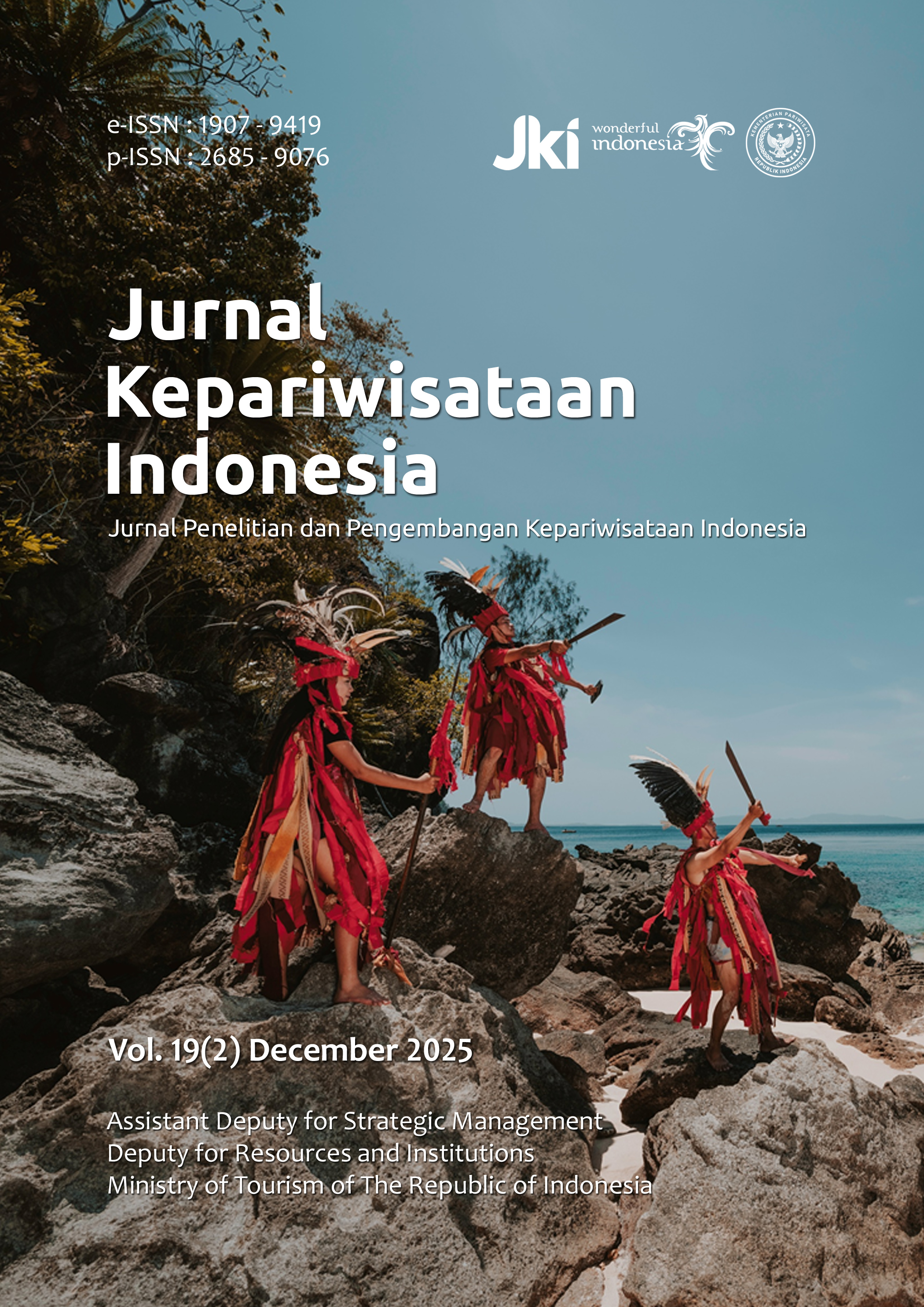
Downloads
Published
Issue
Section
License
Copyright (c) 2025 Juli Suarbawa I Ketut Gde

This work is licensed under a Creative Commons Attribution 4.0 International License.